
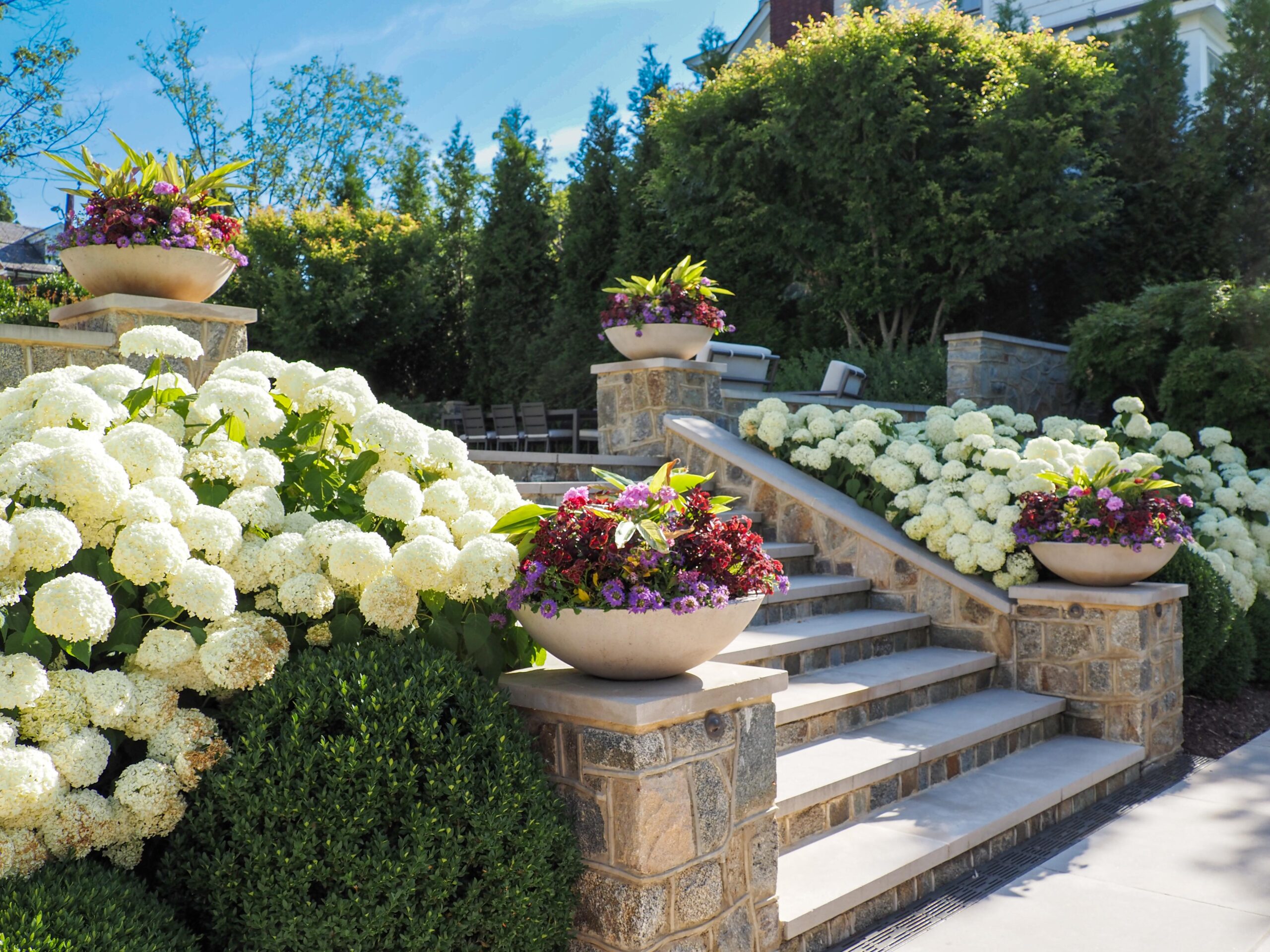
The day a new landscape is finished is not the day the hard work ends. It is the day it begins.
Most homeowners assume the landscape will take care of itself once plants are in the ground and hardscape is set. For the first few weeks, that appears to be true. Then summer arrives. Or the first hard frost. Quietly, in ways not immediately visible, the landscape either takes hold or begins to fail.
Year one is when that outcome is decided. The decisions made during the first twelve months determine whether a new landscape matures into what it was designed to be or slowly diverges from it. Watering, fertilizing, pruning, monitoring, and adjusting all matter more now than they ever will again. By the time problems become obvious, they are considerably harder to fix.
This is what McHale’s landscape maintenance program does differently in year one, and why that first year matters most.
Why New Landscapes Are More Vulnerable Than Established Ones
An established landscape has root systems that spent years finding water, building structure, and adapting to the site’s specific soil conditions. A newly installed landscape has none of that. Every plant on the property is starting from scratch.
Transplant stress is the immediate challenge. Even healthy, well-specified plants experience a period of shock after installation. Root systems disrupted during the move need time to regenerate before they can support the canopy above. During that period, the plant draws on reserves rather than actively growing. Visible stress often does not appear until weeks after installation, when those reserves run low.
Soil conditions compound the problem. New construction properties in Clarksburg and similar markets typically have compacted subsoil beneath a thin topsoil cap. Roots that hit compacted layers stop growing outward and downward. Without adequate root volume, plants cannot access the water and nutrients they need. They survive the first season and decline in the second.
Water is the most critical variable in year one. Too little and newly installed plants desiccate before roots establish. Too much and anaerobic conditions promote root rot. The right amount depends on species, soil type, drainage, sun exposure, and rainfall. All of those factors change week by week through the season. Getting it right requires attention and adjustment, not a fixed schedule.
The Watering Mistakes That Cause Most Year-One Failures
Watering errors account for more year-one plant losses than any other single cause. Most fall into one of three patterns.
The first is overreliance on irrigation systems. A properly programmed system is valuable, but it cannot replace site-specific judgment. Irrigation runs on a schedule. Plants need water based on conditions. A week of overcast, humid weather requires less irrigation than the system delivers. A heat wave in August may require more. Homeowners who set a schedule in May often discover in September that the programming stopped matching conditions months earlier.
The second mistake is surface watering that does not reach the root zone. Light, frequent watering keeps the top inch of soil moist and encourages shallow roots. Deep, less frequent watering drives roots downward to where moisture persists between rain events. Plants with deep root systems are significantly more drought-tolerant and winter-hardy. The difference is not visible at the surface. It becomes apparent when the first dry stretch of summer arrives.
The third mistake is stopping too soon. Many homeowners reduce watering in September because temperatures drop and rainfall increases. In the Mid-Atlantic, however, plants continue establishing root systems through October and into early November. Consistent moisture during that period is critical for winter survival. This is especially true for broadleaf evergreens like hollies, boxwoods, and rhododendrons, which continue losing water through their leaves even when the ground is cold.
What Fertilization in Year One Actually Does
The purpose of fertilization in a newly installed landscape is different from its purpose in an established one. Established plants benefit from nutrient supplementation to support growth and seasonal performance. Newly installed plants need fertility management that supports root development. Pushing top growth faster than the root system can sustain it is counterproductive.
Excessive nitrogen in year one is the most common fertilization mistake. High nitrogen encourages lush foliage growth, which increases water demand on a root system not yet capable of meeting it. The result is a plant that looks vigorous in spring and collapses under heat stress in July.
McHale’s installation process includes slow-release fertilizer applied at planting. This delivers nutrients at a rate the establishing plant can actually use. Pre-emergent herbicide treatment at installation also reduces weed competition in the critical early months, when newly installed plants are least able to compete for resources.
Soil pH is a separate issue that fertilization alone cannot fix. Many Mid-Atlantic soils are naturally acidic. Plants specified for neutral to alkaline conditions will show nutrient deficiencies regardless of how much fertilizer is applied. A soil test in the first season identifies those conditions early. Adjusting pH is a slow process. Starting it in year one rather than year three makes a meaningful difference in long-term plant health.
Pruning in Year One: Less Than You Think, More Than You Expect
The instinct to prune a new landscape aggressively is understandable. Newly installed shrubs often look loose and unstructured. In most cases, that instinct should be resisted.
Heavy pruning in year one reduces the leaf area a plant uses to generate energy through photosynthesis. For a plant already stressed by transplanting, removing that capacity slows establishment. Light corrective pruning to remove damaged or crossing branches is appropriate. Hard shaping cuts should generally wait until the plant has completed one full growing season and shown that it is establishing well.
The exception is deadheading and removal of spent flower material. This redirects energy toward root development rather than seed production. Perennials and flowering shrubs benefit from consistent deadheading in the first season for this reason.
Ornamental grasses and perennials that die back in winter should be left standing through the cold months. The dried material insulates the crown and provides winter garden interest. Cutting back in late winter, before new growth emerges in spring, is the right timing for most species across Annapolis, McLean, and Clarksburg.
Monitoring: What Professionals Catch That Homeowners Miss
The most valuable thing a professional landscape maintenance program provides in year one is not labor. It is observation.
McHale’s trained horticulturists visit maintained properties on a scheduled basis. They look at plants the way a clinician looks at a patient: not just for obvious problems, but for early indicators of stress that are not yet causing visible decline. Leaf color changes that precede nutrient deficiency. Crown dieback patterns that indicate root stress before visible wilt. Soil moisture conditions that predict performance problems weeks out.
Early intervention is almost always less expensive than late intervention. A plant showing early signs of iron chlorosis responds to a soil amendment. The same plant, six months later with significant dieback, may not recover. A drainage problem identified in the first growing season can be corrected before it damages hardscape. Found two years later, the same problem may have undermined a wall footing or heaved a patio section.
McHale’s garden care program for newly installed landscapes includes regular monitoring visits through the first full growing season. Those visits are structured specifically to catch establishment problems early, when corrections are still straightforward.
What Year One Looks Like with McHale’s Maintenance Program
For clients who engage McHale for landscape maintenance following a design-build project, year one includes several protocols beyond standard maintenance visits.
First, a post-installation walkthrough with the design team establishes baseline conditions and identifies any plants showing early transplant stress. That information shapes the first season’s watering and monitoring plan.
Second, McHale’s maintenance crews work from the original planting plan, not just from visible conditions. They know which species are on the property, what establishment timeline each requires, and what indicators to watch for. A crew unfamiliar with the design treats every plant the same. A crew working from the original plan treats each plant according to its specific needs.
Third, because McHale owns and operates its own nursery, replacement plants are sourced from the same supply chain as the original installation. Replacements match in size, form, and provenance rather than arriving as whatever the local nursery has in stock.
Licensed and certified by the Maryland and Virginia Departments of Agriculture, McHale’s team follows strict nutrient management guidelines across all four markets. That compliance matters particularly on Annapolis and Easton waterfront properties. Nutrient runoff into tidal waters is both an environmental concern and a regulatory one on those sites.
If you have recently completed a landscape installation or are planning one, the time to think about year-one maintenance is before the project is finished. Contact McHale to discuss how our maintenance program supports new landscape establishment across Annapolis, McLean, Clarksburg, and Easton.

